
Building a Creative Asset Management Platform for a Mid-Market US Publisher
Our NDA client is a mid-market US AdTech publisher operating a network of content sites that serves thousands of ad creatives per month from hundreds of advertisers. As campaign volume grew, the ad operations team found itself buried in manual work. Creative assets arrived via email, Slack, and file-sharing links. Reviews happened in scattered threads with no central record. Approvals were tracked in spreadsheets that fell out of date within hours. When a non-compliant creative slipped through and ran on a premium placement, the team had no audit trail to trace who approved it or when. Industry research shows that publishers with structured creative review workflows reduce compliance incidents by 50–70% and cut review cycle times by 40–60% compared with ad-hoc manual processes. The client partnered with Advantrix Labs to build a purpose-built asset management platform that would bring order to the creative lifecycle — from upload through review, approval, and delivery.
Project Snapshot
Client profile
Our NDA client is a mid-market US AdTech publisher operating a network of niche content sites across several verticals. The network processes over 3 000 creative assets per month from 400+ active advertiser accounts. The ad operations team of roughly 25 people handles creative intake, format validation, brand safety review, compliance checks, and trafficking to the ad server. Before engaging Advantrix Labs, the entire creative lifecycle ran on a patchwork of email, Slack messages, shared drives, and spreadsheets — with no centralized system, no version control, and no audit trail.
Project goal
Build an internal creative asset management platform that delivers the following.
- A centralized asset library where the ops team can upload, search, filter, tag, and organize every creative asset — replacing scattered file storage and email attachments
- Structured multi-stage approval workflows with configurable review steps, role-based assignments, and automatic escalation so that every asset follows a consistent path from submission to approval or rejection
- A complete decision log recording every review action — who reviewed, when, what they decided, and why — giving the team full traceability and an audit trail for compliance
- Version history with visual comparison so reviewers can see exactly what changed between revisions
- Real-time collaboration through threaded notes, @mentions, and status notifications so that feedback and decisions happen inside the platform
- Automated format and specification validation that checks assets against placement requirements on upload, catching errors before they enter the review queue
- Integration with the ad server to automatically push approved assets into delivery and pull back live status
Business challenge
Managing thousands of ad creatives per month through manual, disconnected processes created compounding operational problems as the publisher network grew.
- No centralized asset repository: Creative files lived in email attachments, Slack threads, Google Drive folders, and local desktops. Finding a specific asset or its latest version meant searching across multiple systems. During audits or advertiser disputes, locating the approved version and its review history was nearly impossible
- Manual approval workflows with no structure: Reviews happened informally — a manager would look at a creative, reply in email or Slack, and someone would update a spreadsheet. There was no consistent sequence of checks and no way to enforce that every asset passed through brand safety, format compliance, and editorial review before going live
- Zero traceability and no decision logs: When a non-compliant creative ran on a premium placement, the team could not trace who approved it, when, or what criteria they applied. Advertiser disputes about rejected creatives had no supporting documentation, creating compliance risk and eroding trust with premium partners
- No version control: Advertisers frequently revised creatives after feedback. Updated files arrived in new emails, and the team had no reliable way to track which version was current or what changed. Reviewers sometimes approved outdated versions by mistake
- Communication scattered across channels: Feedback on a single creative might span an email chain, two Slack threads, and a spreadsheet comment. Reviewers missed context, gave conflicting feedback, and duplicated work
- Peak-period bottlenecks: During major campaign launches, the volume of incoming assets spiked. Without bulk processing or workflow automation, the ops team fell behind, delaying campaigns and straining advertiser relationships
Solution
Advantrix Labs partnered with the client to design and build an internal creative asset management platform that replaces the manual patchwork with a structured, auditable system for every stage of the creative lifecycle.
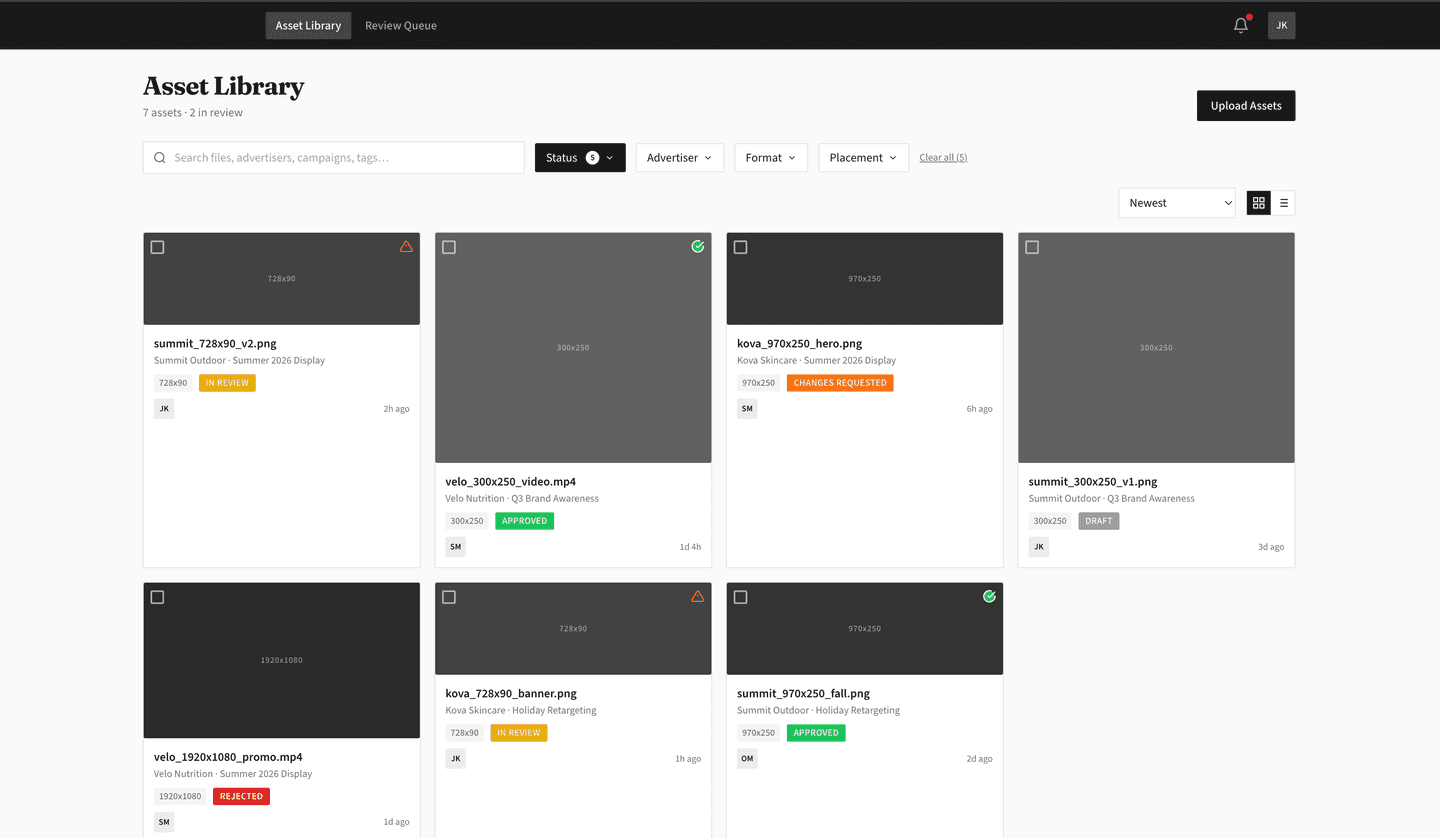
- Centralized asset library: A searchable repository holds every creative with metadata — advertiser, campaign, placement, format, dimensions, and status. Full-text search, multi-attribute filtering, and drag-and-drop upload handle single files and bulk batches. Every asset gets a permanent record and complete history from the moment it enters the system
- Automated specification validation: On upload, the platform checks each asset against placement requirements — dimensions, file size, aspect ratio, video duration, and format. Assets that fail validation are flagged immediately with specific errors, preventing non-compliant files from entering the review queue
- Configurable approval workflows: Multi-stage review workflows support format validation, brand safety review, editorial review, and final sign-off. Each stage has assigned reviewers, SLA deadlines, and automatic escalation. The ops lead configures workflows per asset type or placement tier without engineering involvement
- Decision log and audit trail: Every action is recorded — uploads, status changes, review decisions, reviewer identity, timestamp, and rationale. The log is searchable and exportable. When a dispute or compliance question arises, the team pulls the complete approval chain with every decision in chronological order
- Version history with visual comparison: Revised assets link to the original as new versions. Side-by-side comparison shows exactly what changed. Reviewers see the full timeline and the system prevents accidental approval of outdated versions
- Threaded notes and @mentions: Every asset has a dedicated comment thread with real-time notifications. @mentions tag colleagues directly, and the full conversation stays attached to the asset permanently
- Bulk operations and priority queues: The ops team selects multiple assets for batch actions — approve, reject, reassign, or tag. A priority queue surfaces assets approaching SLA deadlines and those from premium advertisers
- Ad server integration: Approved assets push automatically to the ad server. Delivery status pulls back into the platform, keeping the ops team informed without checking the ad server separately
Solution gallery
Product and workflow visuals from the delivered solution.
Business outcomes
By replacing scattered manual processes with a structured asset management platform, Advantrix Labs gave the ad operations team a single system of record for every creative that flows through the publisher network.
- 65% reduction in asset review turnaround: structured workflows with automated specification checks, assigned reviewers, and SLA escalation replaced ad-hoc email reviews, getting assets from upload to approval in hours instead of days
- Zero unapproved assets reaching delivery: enforced approval workflows with required sign-offs at every stage eliminated the compliance gap that previously allowed unchecked creatives to go live on premium placements
- Complete audit trail from upload to delivery: the decision log gives the team instant access to who reviewed what, when, and why — resolving advertiser disputes in minutes and satisfying compliance requirements
- 50% reduction in ops communication overhead: threaded notes, @mentions, and version history inside the platform replaced email chains, Slack threads, and spreadsheet comments
- 3x faster peak-period processing: bulk operations and priority queues let the team handle campaign launch surges without falling behind or delaying advertiser timelines