
Boosting Programmatic Revenue with Header Bidding for BidStream
BidStream, an ad‑tech start‑up, needed to optimise its advertising stack to maximise yield across its premium content. The company operated its own publishing platform but relied on legacy waterfall selling, where each demand partner was called sequentially until an ad slot was filled. This approach lacked transparency and often left revenue on the table because later bidders never had the opportunity to compete. BidStream wanted to adopt header bidding with Prebid.js to enable simultaneous auctions, integrate verification to protect brand safety and analytics to drive data‑driven decisions.
Project Snapshot
Client profile
BidStream is a venture‑backed ad‑tech start‑up that operates a digital publishing platform. To monetise its inventory, the publisher connects with multiple demand sources and ad exchanges. Prior to this project, the site used a traditional waterfall setup through its ad server, prioritising a handful of partners. As a result, bids from most exchanges were never considered, leaving potential revenue unrealised.
Project goal
Build a programmatic advertising layer with the following capabilities.
- Implements header bidding using Prebid.js to allow multiple demand partners to compete simultaneously
- Integrates DoubleVerify or a similar verification service to ensure ads are viewable, fraud‑free and brand‑safe
- Provides real‑time analytics and dashboards for yield optimisation and inventory management
- Delivers predictable revenue and transparent auctions for both the publisher and its advertisers
Business challenge
Publishers using the waterfall model call ad exchanges one after another. Early partners in the chain see the impression first and can buy at a low price, while later partners never have the opportunity to bid, leaving revenue on the table. Because demand sources are contacted sequentially, the setup lacks transparency—publishers cannot easily see who bid on each impression or at what price. BidStream faced several challenges.
- Revenue leakage and poor fill rates: Without simultaneous auctions, only a fraction of demand partners could bid, limiting competition. Industry research shows that header bidding typically increases programmatic revenue by 20–50 % by allowing all buyers to bid at once
- Limited transparency and control: Waterfall auctions obscure which partners bid on each impression and at what price. Header bidding provides clear visibility into demand sources, bid prices and win rates
- Brand safety and fraud prevention: Serving ads without verification exposes publishers to fraud and unsuitable content. Independent verification helps ensure that ads are viewable, free from invalid traffic and placed in brand‑safe environments
- Technical complexity: Implementing header bidding and integrating verification and analytics requires a coordinated front‑end and back‑end architecture, with low latency and robust data pipelines
Solution
Advantrix Labs partnered with BidStream to design and implement a header‑bidding platform based on Prebid.js. The solution centralises auctions, verifies supply quality and provides granular analytics.
- Open‑source header bidding: Prebid.js runs in the page header and sends bid requests to all connected demand partners simultaneously. When the page loads, the Prebid wrapper fetches bids and creatives from each SSP and exchange. Once the timeout expires, the highest bid is passed to the publisher’s ad server, which then compares it with direct‑sold campaigns and renders the winning creative. This unified auction maximises revenue by ensuring the highest‑paying advertiser wins each impression
- Ad verification and brand safety: The platform integrates with DoubleVerify’s verification APIs to confirm that ads are viewable, free from fraudulent activity and delivered in brand‑safe environments. This reduces ad waste, protects brand reputation and provides actionable insights for optimisation
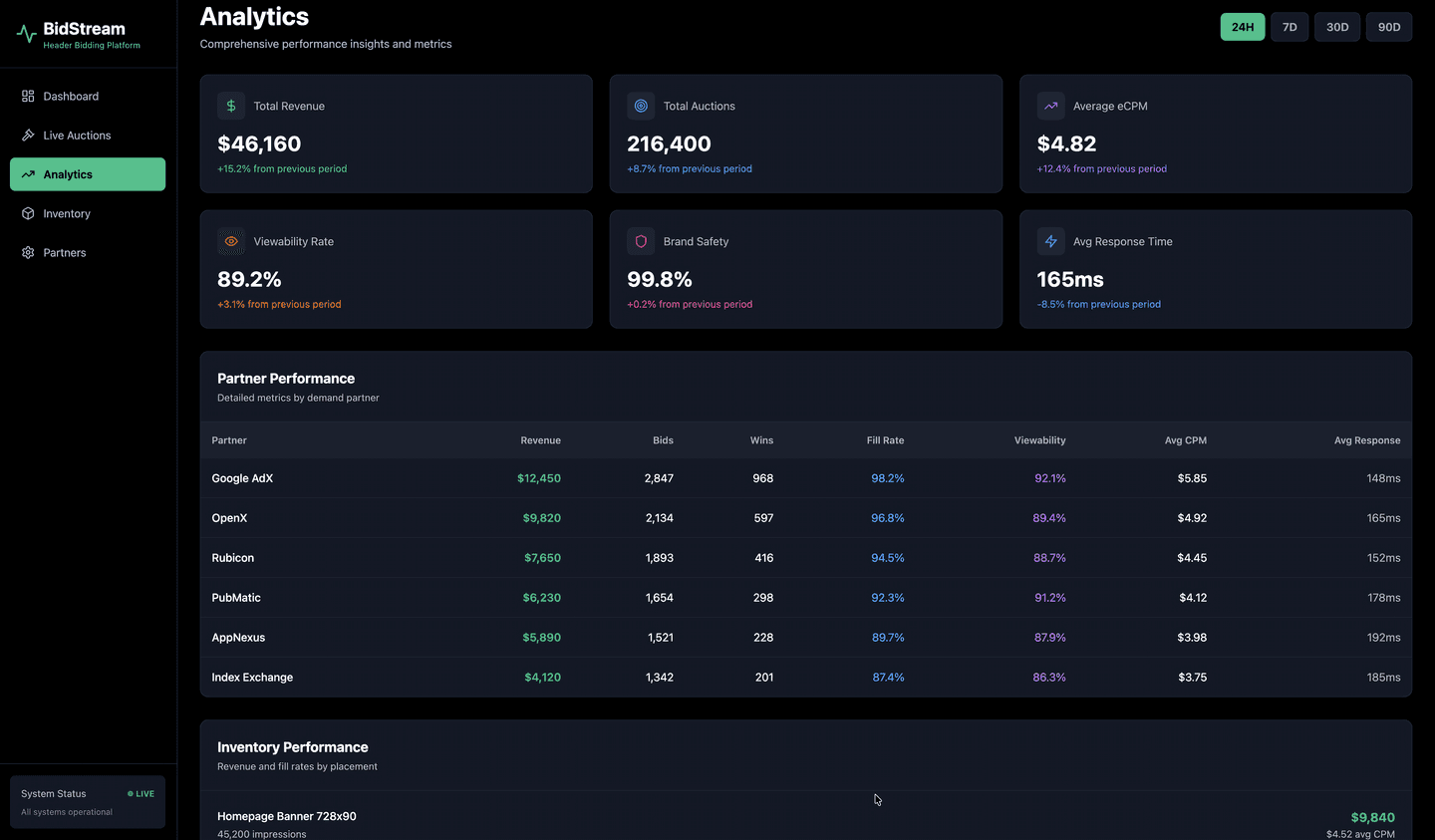
- Analytics and inventory management: Real‑time dashboards track bid responses, win rates and revenue across demand partners. The system exposes metrics such as effective CPM, fill rates and viewability, enabling publishers to optimise bidder configurations and price floors
- Platform integration: Back‑end services expose RESTful APIs that normalise bid data, enforce security and orchestrate auctions. The front‑end provides a responsive UI for administrators to configure bidders, review analytics and manage inventory. Deployment uses AWS infrastructure, with serverless functions handling low‑latency bidding logic and persistent storage in managed databases
Solution gallery
Product and workflow visuals from the delivered solution.
Business outcomes
By implementing a transparent, open‑source header‑bidding solution with integrated verification and analytics, Advantrix Labs delivered a modern programmatic advertising platform that maximises yield, protects brand integrity and positions BidStream for sustainable growth.
- 35 % lift in programmatic revenue: simultaneous auctions and real‑time competition across demand partners captured spend that the waterfall model left on the table, delivering measurable yield growth within months of launch
- 100 % visibility into bid‑level data: real‑time dashboards exposed bidder performance, win rates and pricing for every impression, enabling data‑driven floor‑price optimization and partner negotiations
- Zero brand‑safety incidents post‑launch: DoubleVerify integration ensured all ads are viewable, fraud‑free and brand‑safe, protecting advertiser relationships and giving BidStream a credible pitch to premium demand partners