Building a Promotion and Retention Intelligence Platform for a Mid-Market B2C eCommerce Brand
Hartwell is a mid-market US B2C eCommerce brand selling home and lifestyle products, generating roughly $12 million in annual revenue through its custom storefront. The marketing team ran 15-20 concurrent promotions at any given time — discount codes, loyalty point multipliers, referral bonuses, flash sales, seasonal bundles — but managed each one in a different tool. Email campaigns lived in one platform, discount codes in the storefront admin, loyalty rules in a third-party app, and results tracking in spreadsheets assembled weekly. Nobody could answer the basic questions: which promotions actually drive profitable repeat purchases, and which ones just erode margin? Industry data paints a clear picture of why this matters. Customer acquisition costs in eCommerce have surged 222% over the past decade, reaching $29 per new customer (Sobot, 2025). A 5% increase in customer retention can boost profits by 25-95% (Bain & Company). And yet the average online retailer repeat purchase rate sits at just 28.2% (Shopify, 2025) — meaning most brands lose nearly three out of four first-time buyers. Hartwell knew retention was the lever but had no system to pull it. They partnered with Advantrix Labs to build a platform that would unify promotion management, connect it to retention analytics, and turn scattered campaigns into a measurable growth engine.
Project Snapshot
Client profile
Hartwell is a mid-market US B2C eCommerce brand with a curated catalog of home and lifestyle products, generating approximately $12 million in annual revenue from a custom-built storefront. The company employs around 45 people, including a marketing team of six, a growth lead, and a two-person data analyst team. Hartwell had built a loyal early customer base through strong brand identity and quality products, but as the business scaled, the promotional machinery grew fragmented. Discounts, loyalty programs, referral incentives, and seasonal campaigns were each managed in separate tools with no shared analytics layer and no connection to customer retention metrics.
Project goal
Build a promotion and retention intelligence platform that delivers the following.
- A unified promotion management hub where the marketing team can create, schedule, and manage every promotion type — discounts, loyalty rewards, referral bonuses, bundles, flash sales — from a single interface, replacing four separate tools
- Margin-aware promotion analytics that track not just revenue lift but actual profit impact of each promotion, including discount depth, cannibalization effects, and stacking overlap
- A customer retention dashboard with cohort analysis, repeat purchase funnels, customer lifetime value trends, and at-risk scoring — giving the growth team visibility into where customers drop off and why
- Automated retention workflows triggered by behavioral signals — purchase frequency decline, cart abandonment patterns, engagement drops — so re-engagement happens consistently instead of manually
- A promotion calendar with conflict detection and budget guardrails that prevents accidental discount stacking and margin erosion before promotions go live
Business challenge
Hartwell's marketing team was running more promotions than ever but understanding less about what they were actually doing to the business. Scale made the problem worse, not better.
- Promotions managed across four disconnected tools: discount codes lived in the storefront admin, loyalty rules in a third-party app, email campaigns in a marketing platform, and referral bonuses in yet another tool. The marketing team spent hours each week manually reconciling what was active, what overlapped, and what results each promotion produced
- No visibility into promotion profitability: the team tracked revenue lift but not margin impact. A flash sale might generate $40K in orders but cost $28K in discounts and margin erosion — a fact nobody discovered until the monthly P&L review. Over-reliance on discounting trains customers to wait for sales and structurally erodes margins over time (Symphony Commerce, 2025)
- Repeat purchase rate stuck below industry average: at 22%, Hartwell lagged the 28.2% eCommerce average (Shopify, 2025). The team suspected promotions were driving one-time deal-seekers rather than loyal buyers, but had no cohort analysis to confirm or disprove the theory. Acquisition costs had climbed to $31 per new buyer — making every lost repeat purchase expensive
- No automated retention triggers: when a valuable customer went quiet, nobody noticed until months later. Win-back campaigns were assembled manually once per quarter with generic offers. A 5% improvement in retention can boost profits by 25-95% (Bain & Company) — but Hartwell had no system to act on retention signals in real time
- Promotion conflicts and uncontrolled stacking: without a shared calendar, the team regularly launched overlapping promotions. Customers stacked a site-wide discount with loyalty double-points and a referral bonus simultaneously — pushing average discount depth past 35%, well past the margin break-even point. There were no guardrails and no approval workflow
Solution
Advantrix Labs partnered with Hartwell to build a promotion and retention intelligence platform that connects to the existing storefront via API and gives the marketing team a single system for managing promotions, measuring their true impact, and automating customer retention.
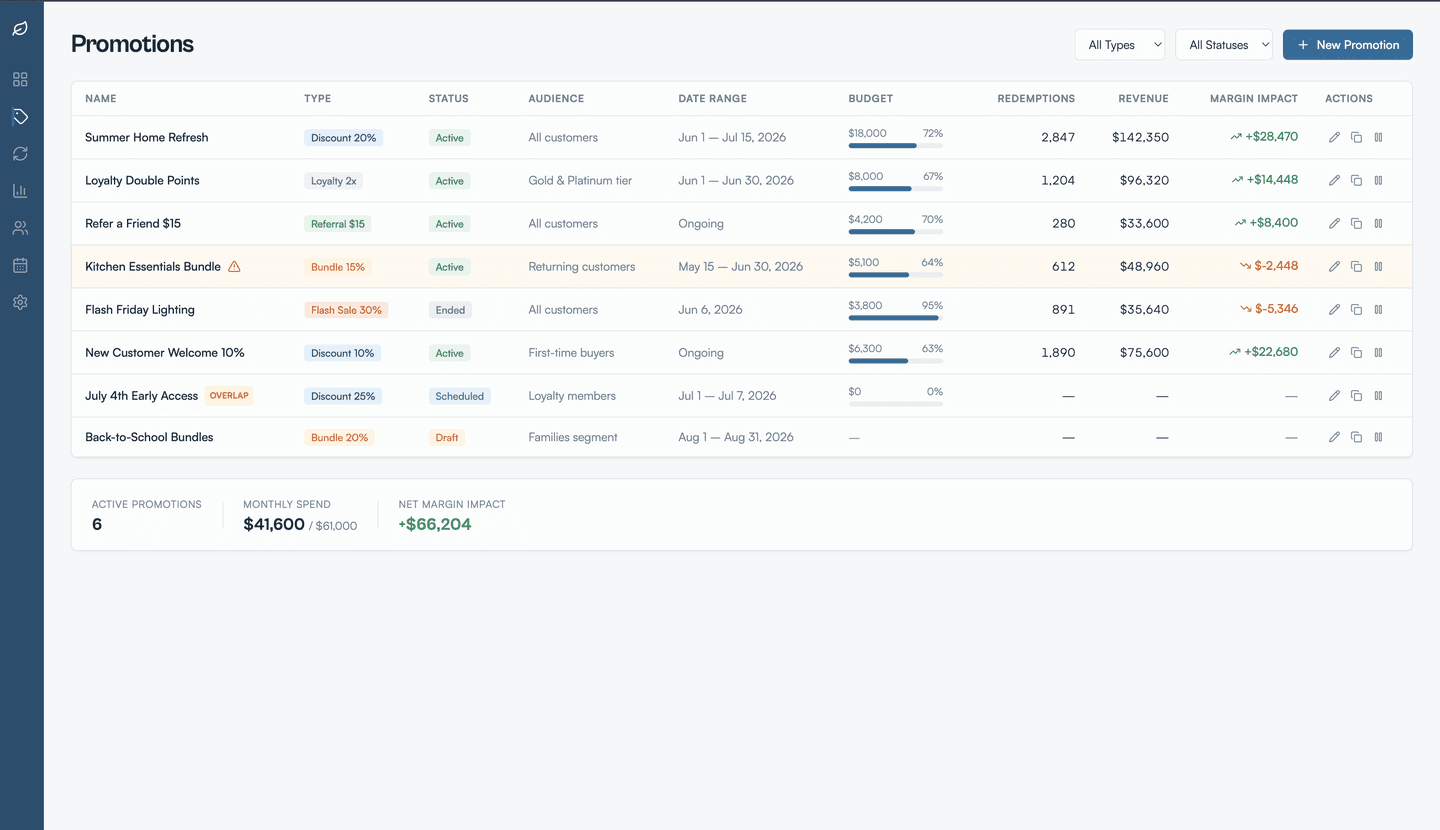
- Unified promotion management hub: a central interface where the marketing team creates and manages every promotion type — percentage and fixed discounts, buy-one-get-one, loyalty multipliers, referral bonuses, free shipping thresholds, flash sales, and bundles. Each promotion has defined audience segments, date ranges, budget caps, and stacking rules, with real-time redemption counts and spend tracking
- Margin-aware promotion analytics: every promotion is tracked by gross margin impact, discount depth distribution, incremental vs. cannibalized sales, and acquisition vs. retention contribution. The analytics layer connects redemption data to order-level margin data so the team sees actual profit impact — not just top-line lift. Historical comparisons show how similar promotions performed in previous periods
- Customer retention dashboard: cohort-based analysis showing repeat purchase rates by acquisition channel, first-order promotion, product category, and time period. CLV trends, purchase frequency distributions, and a churn risk score for each customer based on recency, frequency, and monetary value signals. The growth team identifies which promotions produce loyal repeat buyers versus one-time deal-seekers
- Automated retention workflows: rule-based triggers fire re-engagement actions when behavioral signals indicate risk — purchase frequency declining below baseline, cart abandonment exceeding threshold, no site activity for a configurable period, anniversary milestones. Each trigger maps to personalized retention actions with performance tracking for every trigger-action pair
- Promotion calendar with conflict detection: a visual calendar of all promotions with automatic conflict alerts when promotions overlap in audience, timing, or stacking eligibility. Budget guardrails flag promotions that would push discount exposure past the margin threshold. The growth lead approves or adjusts before promotions go live
Solution gallery
Product and workflow visuals from the delivered solution.
Business outcomes
By replacing disconnected tools and blind discounting with a unified, margin-aware promotion and retention platform, Advantrix Labs gave Hartwell the visibility and automation to turn promotions from a cost center into a growth engine.
- Repeat purchase rate improved from 22% to 29%: cohort-level retention analytics revealed which acquisition promotions drove loyal buyers and which attracted one-time deal-seekers. The team reallocated budget toward high-retention channels, pushing the repeat rate past the 28.2% industry average within five months
- $340K in net revenue recovered from automated retention workflows in six months: automated triggers caught at-risk customers weeks earlier than quarterly manual campaigns, with personalized offers converting at 3x the rate of the old batch approach
- 18% reduction in promotion-related margin erosion: conflict detection and stacking guardrails eliminated uncontrolled discount overlap, and margin-aware analytics helped the team retire three underperforming promotions that had been running for over a year
- 65% faster promotion setup: creating and launching a promotion went from a multi-tool, multi-hour process to under 15 minutes in the unified hub with audience targeting, budget caps, and stacking rules configured in one workflow
- CLV increased 24% in the first tracked cohort: customers acquired through retention-optimized promotions showed higher purchase frequency, larger average order values, and longer active lifespans compared to the pre-platform baseline