Building an AI-Powered Data Analytics Platform for a Data Technology Start-Up
An NDA client is a data technology start-up developing an AI platform that removes the SQL barrier from business analytics. Despite growing investment in business intelligence tools, research shows that only 24% of employees consider themselves data literate, and analysts spend up to 80% of their time on data preparation rather than insight generation. The client recognised that traditional BI platforms still require technical expertise to extract value, leaving most business users dependent on data teams for even routine queries. The start-up set out to build a platform where anyone could ask questions of their data in plain English and receive accurate, visualised answers in seconds.
Project Snapshot
Client profile
Our NDA client is an early-stage data technology start-up building an AI-powered analytics platform for business teams. The company targets organisations where data access is bottlenecked by a small number of technical analysts, leaving business users unable to self-serve insights. Before engaging Advantrix Labs, the client had validated the concept with early design work but needed the engineering capability to build a production-grade platform that could reliably translate natural language into accurate database queries at scale.
Project goal
Build a full-stack AI data analytics platform with the following capabilities.
- An intelligent chatbot interface that allows non-technical users to query databases using natural language, eliminating the need to write SQL
- Automated report generation and data visualisation that transforms query results into charts, tables and dashboards
- A GraphQL data aggregation layer that unifies data from multiple sources into a single query interface
- A Python AI microservice that handles natural language processing, query translation and context-aware conversation management
- A responsive, intuitive frontend that makes data exploration accessible to users with no technical background
Business challenge
Organisations invest heavily in data infrastructure but struggle to extract value because most employees lack the technical skills to access it directly. Traditional BI tools require SQL proficiency or complex drag-and-drop query builders that still demand a mental model of the underlying data schema. The client's target customers faced several compounding problems.
- SQL dependency and data access bottleneck: every data request flowed through a small analytics team. Business users across marketing, operations and finance waited days for answers that, with the right tooling, could be resolved in seconds
- Slow reporting cycles: analysts spent up to 80 % of their time on data wrangling and preparation rather than insight generation, trapped in repetitive extraction tasks while stakeholders waited
- Data silos and fragmented sources: information lived across multiple databases, data warehouses and third-party systems with no unified access. Users manually reconciled outputs from different teams, introducing errors and inconsistency on top of the delay
Solution
Advantrix Labs partnered with the client to architect and build the AI data analytics platform from the ground up, focusing on accuracy of query translation, speed of insight delivery and accessibility for non-technical users.
- Natural language query engine with AI chatbot: The core of the platform is a Python AI microservice that interprets user questions expressed in plain English and translates them into precise database queries. The chatbot maintains conversational context, allowing users to ask follow-up questions, refine results and drill into specific data points without restarting the query process. The system handles ambiguity through clarifying prompts and maps business terminology to the underlying data schema, ensuring that users do not need to understand table structures or join logic
- Automated report generation and visualisation: Query results are automatically transformed into appropriate visual formats including charts, graphs, tables and summary dashboards. The platform selects visualisation types based on the nature of the data and the user's question, reducing the manual effort of formatting and presenting findings. Users can customise, save and share reports directly from the interface
- GraphQL data aggregation layer: A GraphQL API serves as the data unification layer, aggregating information from multiple databases and external sources into a single, flexible query interface. This eliminates the need for users to know where data resides or how systems connect. The GraphQL layer also reduces over-fetching and enables the frontend to request precisely the data it needs, improving performance and responsiveness
- Responsive, accessible frontend: The user interface delivers a responsive, accessible experience that prioritises simplicity for non-technical users. The design guides users through the query process with minimal friction, presenting results in clear, actionable formats. Server-side rendering ensures fast initial load times and smooth navigation across dashboards and reports
- Scalable backend architecture: The backend provides a structured, modular API layer that handles authentication, data routing, session management and communication between the frontend, the AI microservice and the data aggregation layer. The architecture supports horizontal scaling as user volume and query complexity grow
- Intelligent query optimisation: The AI microservice includes query optimisation logic that analyses generated SQL for performance before execution. This reduces unnecessary joins, applies appropriate indexing hints and manages query complexity to maintain low latency even against large datasets
Solution gallery
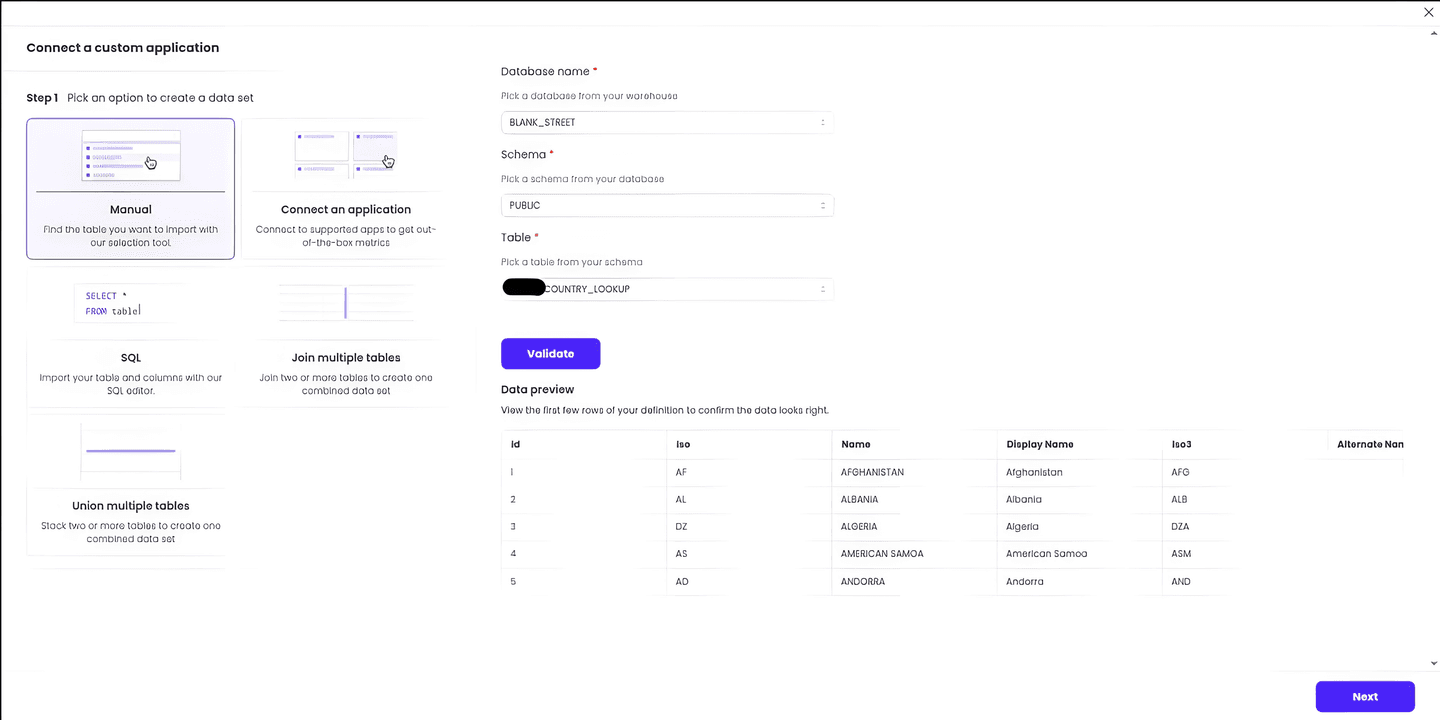
Product and workflow visuals from the delivered solution.
Business outcomes
By delivering an AI-powered analytics platform that translates natural language into database queries, Advantrix Labs helped the client remove the technical barrier between business users and their data, transforming how organisations access and act on information.
- 75% reduction in manual reporting time: Automated query translation and report generation eliminated the repetitive data extraction and formatting work that previously consumed analyst hours. Business users now generate their own reports in seconds, freeing data teams to focus on strategic analysis and modelling rather than ad-hoc query fulfilment
- 60% increase in platform adoption: The natural language interface made data accessible to users who had never interacted with a BI tool. Adoption rates climbed well above industry averages for traditional BI platforms, validating the client's hypothesis that removing the SQL barrier would unlock organisation-wide data engagement
- 50% decrease in data query latency: The combination of the GraphQL aggregation layer, optimised query generation and efficient backend architecture cut average query response times in half. Users receive answers within seconds rather than waiting for manual processing, enabling real-time decision-making
- Democratised data access: Non-technical teams across marketing, operations, finance and leadership gained the ability to explore data independently. This reduced dependency on centralised analytics teams and distributed analytical capability across the organisation, aligning with the broader industry shift toward data democratisation
- Scalable foundation for product growth: The modular architecture, with clearly separated frontend, backend, AI microservice and data aggregation layers, provides the client with a platform that can scale with demand, onboard new data sources and incorporate more advanced AI capabilities without re-engineering the core system