
Visual Workflow Automation Modeller for Appian — From Process Design to Live Execution
Appian Corporation (NASDAQ: APPN), a publicly traded enterprise automation SaaS company, needed a production-grade BPMN 2.0 process modeller embedded inside its platform — one that let business analysts and developers design, publish, and monitor executable workflows through a visual canvas without a development handoff. The goal: a business analyst draws a workflow, publishes it, and it runs in production. Operations teams see exactly where every active instance stands without touching a log.
Project Snapshot
Client profile
Appian Corporation (NASDAQ: APPN) is a publicly traded enterprise automation SaaS company. Its platform enables large organisations to build enterprise-grade workflow applications. Appian's clients run complex, multi-step approval and operational processes — invoice approvals, employee onboarding, procurement requests, insurance claims — across finance, HR, operations, and compliance teams. Hundreds of concurrent workflow instances run at any time across enterprise clients, each requiring reliable execution, real-time status visibility, and accurate audit trails.
Project goal
Build a production-grade BPMN 2.0 process modeller embedded inside Appian's enterprise automation platform that delivers the following.
- A visual canvas where business analysts and developers drag and drop process nodes and wire them into production-executable workflows — no code generation step, no deployment pipeline
- Dual authoring modes at the canvas level: a simplified view for non-technical stakeholders and a full designer mode with data bindings, service configuration, error handling, and retry logic
- Real-time execution monitoring so operations teams see exactly which step each active workflow instance occupies — no log access required
- A process instance dashboard tracking all running, waiting, completed, and failed workflows across enterprise clients, with SLA risk indicators and elapsed-time visibility
- Full lifecycle management for process definitions: draft, publish, version, and retire with a complete execution history
Business challenge
Appian needed to close the gap between process documentation and running software — a gap that forced a development handoff every time a business process changed.
- Process design and deployment were disconnected: business analysts produced BPMN diagrams in documentation tools with no relationship to what engineers deployed. Every process change required a development handoff, introducing delays and translation errors
- No live execution visibility: operations teams had no way to see where a specific workflow instance was stuck in real time. Troubleshooting required log access, which meant engineering involvement for every incident
- Scaling concurrent workflows was opaque: as enterprise clients grew the number of active processes, tracking SLA health, assignee queues, and failed instances became increasingly manual — status emails and spreadsheets instead of a live system of record
Solution
Advantrix Labs built the BPMN 2.0 process modeller as the core authoring and monitoring layer inside Appian's enterprise platform.
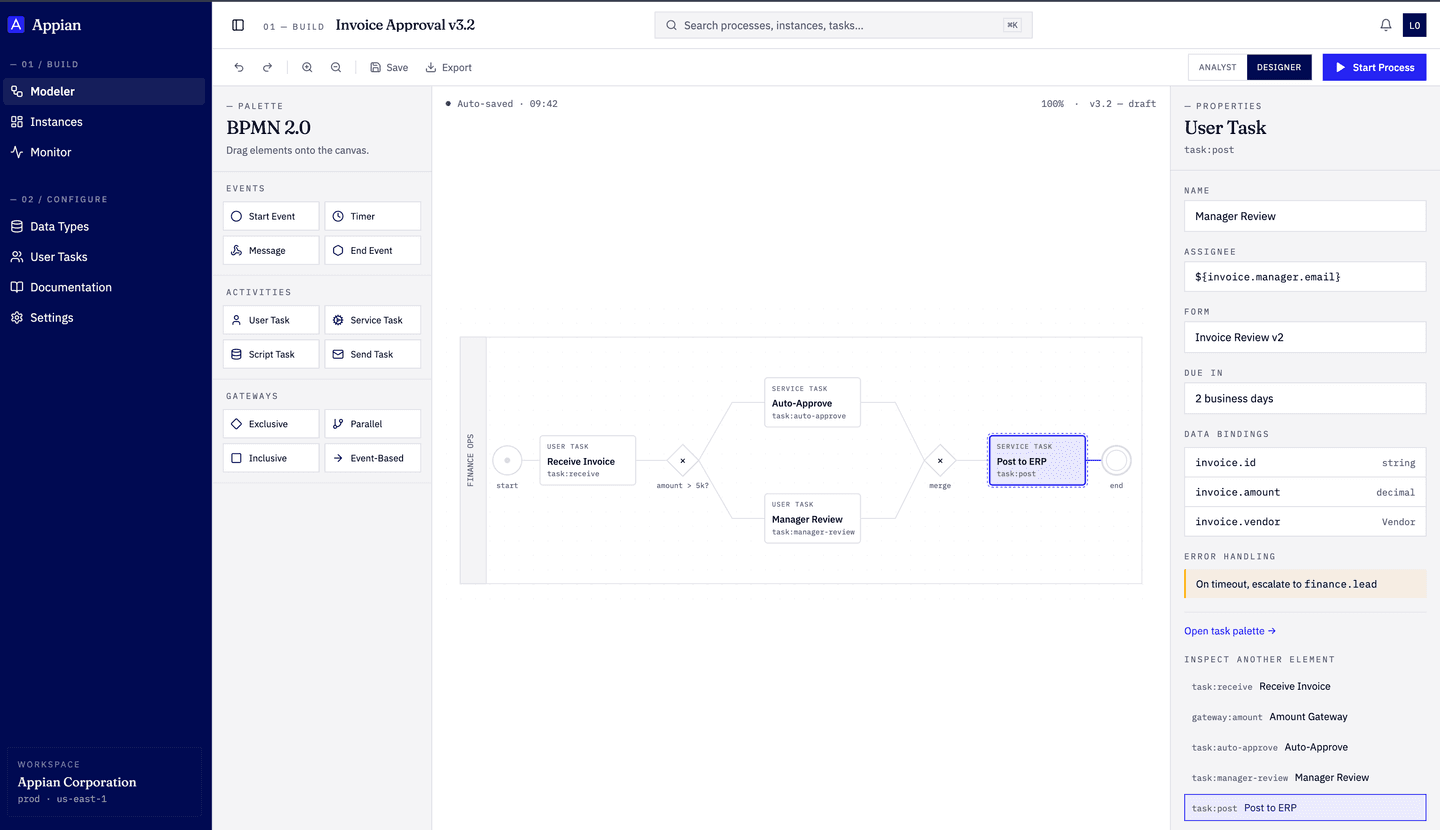
- Visual process canvas with full BPMN 2.0 node library — start events, end events, user tasks, service tasks, gateways, subprocesses, and swimlane pools — so analysts and developers compose processes the way they think about them
- Dual authoring modes at the canvas level: Analyst Mode for non-technical stakeholders building readable process diagrams, Designer Mode for full data binding, service configuration, error boundaries, and retry logic — one process file, both audiences
- Live execution monitoring: each running instance highlights its current node on the canvas in real time, with status colour-coding for active user tasks, waiting service calls, completed steps, and triggered error boundaries
- Process instance dashboard: a unified view of every running, waiting, completed, and failed instance across all deployed processes, with SLA-risk indicators, elapsed time, and assignee queues — auto-refreshed without polling
- Full definition lifecycle: draft, publish, version, and retire process definitions with a stable execution history and rollback path for every production workflow
Solution gallery
Product and workflow visuals from the delivered solution.
Business outcomes
The modeller eliminated the design-to-code handoff and gave operations teams live workflow visibility for the first time.
- 60% faster process deployment: business analysts model and deploy production-grade workflows directly from the visual canvas, cutting the design-to-production cycle that previously required a development handoff for every process change
- 45% reduction in manual coordination overhead: enterprise clients migrated approval and onboarding processes to the platform, replacing email threads, manual status checks, and spreadsheet tracking with automated workflow routing
- 70% faster process debugging: real-time execution monitoring pinpoints exactly where a stuck instance is and why — operations teams resolve incidents in seconds instead of tracing logs with engineering support