
Building a Sustainability Analytics Platform for Verde
Verde, an ESG start-up, set out to build an enterprise SaaS platform for sustainability tracking and environmental analytics. With ESG reporting moving from voluntary to mandatory across major economies, organisations face mounting pressure to measure, monitor and disclose environmental impact. The global ESG software market is expected to exceed $2.5 billion by 2027, and the EU's Corporate Sustainability Reporting Directive (CSRD) alone will require over 50,000 companies to report standardised sustainability data. The start-up identified a gap in the mid-market for a modern, intuitive analytics platform that could help enterprises navigate regulatory complexity, aggregate environmental data from disparate sources and transform it into actionable dashboards and compliance-ready reports without requiring dedicated sustainability engineering teams.
Project Snapshot
Client profile
Verde is a venture-backed start-up building an enterprise SaaS platform for sustainability tracking and ESG analytics. The company targets mid-market and enterprise organisations that need to collect environmental data, monitor carbon emissions, track resource consumption and generate compliance reports but lack the in-house engineering capacity to build custom sustainability infrastructure. Before engaging Advantrix Labs, Verde had validated demand through early conversations with prospective enterprise customers but needed to move from concept to a production-grade platform capable of handling large-scale environmental datasets and meeting the expectations of enterprise buyers.
Project goal
Build a full-stack sustainability analytics platform with the following capabilities.
- Aggregates environmental data from multiple sources including IoT sensors, utility providers, supply chain systems and manual inputs into a unified data model
- Delivers complex data visualisation dashboards that render large environmental datasets with minimal latency, enabling users to explore emissions trends, resource consumption and compliance status
- Supports real-time data updates via API integration with backend RESTful services, ensuring dashboards reflect the latest environmental metrics as data flows in
- Enterprise-grade authentication with support for Google and corporate single sign-on, meeting enterprise security and procurement requirements
- Implements server-side rendering for public-facing pages including sustainability reports, benchmarks and educational content to support organic discovery and SEO
- Maintains backward compatibility with legacy modules during the transition to a modern architecture
Business challenge
Entering the enterprise sustainability software market as a start-up requires meeting a demanding combination of data complexity, regulatory rigour and enterprise-grade experience. Organisations managing ESG data deal with heterogeneous data sources, evolving reporting frameworks and large volumes of time-series environmental metrics. The start-up faced several challenges.
- Environmental data complexity and scale: Sustainability data originates from dozens of disparate sources, including IoT sensors, utility billing systems, supply chain platforms and manual spreadsheet uploads. Each source uses different formats, units and reporting intervals. A McKinsey analysis found that ESG data management is one of the most significant barriers to corporate sustainability reporting, with companies spending an average of 10,000 hours annually on data collection and preparation. The platform needed to normalise and aggregate this data into coherent, queryable datasets without losing granularity
- Regulatory compliance and reporting frameworks: The regulatory landscape for ESG reporting is accelerating. The EU's CSRD, the SEC's proposed climate disclosure rules and frameworks like GRI, SASB and TCFD each require specific metrics, reporting periods and disclosure formats. A platform that cannot map data to multiple frameworks simultaneously risks becoming irrelevant as regulations evolve. The start-up needed to build a data model flexible enough to support current and future compliance requirements
- Dashboard performance for large datasets: Enterprise sustainability dashboards must render thousands of data points across time-series charts, geographic heat maps and drill-down tables. Slow rendering erodes user trust and reduces adoption. Research from Google indicates that 53% of users abandon a page if it takes longer than three seconds to load, and in enterprise SaaS, dashboard responsiveness directly correlates with user engagement and retention
- Trial-to-paid conversion for enterprise SaaS: Enterprise buyers evaluate platforms during trial periods, and first impressions determine whether a deal progresses. Sustainability teams often have limited technical expertise, so the platform must demonstrate value quickly through intuitive onboarding and immediate insight delivery. SaaS companies with optimised onboarding flows achieve two to three times higher trial-to-paid conversion rates, yet the start-up's initial prototype lacked the polish and performance needed to convert enterprise evaluators into paying customers
- Enterprise adoption and security requirements: Enterprise procurement teams require SSO integration, role-based access control and compliance with security standards before approving new software. Without these capabilities, a start-up cannot pass enterprise vendor reviews, regardless of product quality
- Legacy module compatibility: The start-up had built early features using Vue.js. A complete rewrite would delay launch, so the new React/Next.js architecture needed to integrate with existing Vue.js modules during a phased migration
Solution
Advantrix Labs partnered with Verde to architect and build a production-grade sustainability analytics platform from the ground up. The system is designed around three pillars: enterprise-grade data handling, high-performance visualisation and frictionless adoption.
- Component-based frontend: The frontend uses a strict component-based architecture with a consistent design system. Every dashboard, report view and settings screen scales from summary-level executive views to granular data exploration. The component architecture enables rapid iteration on new visualisation types as sustainability frameworks evolve, without re-engineering existing screens
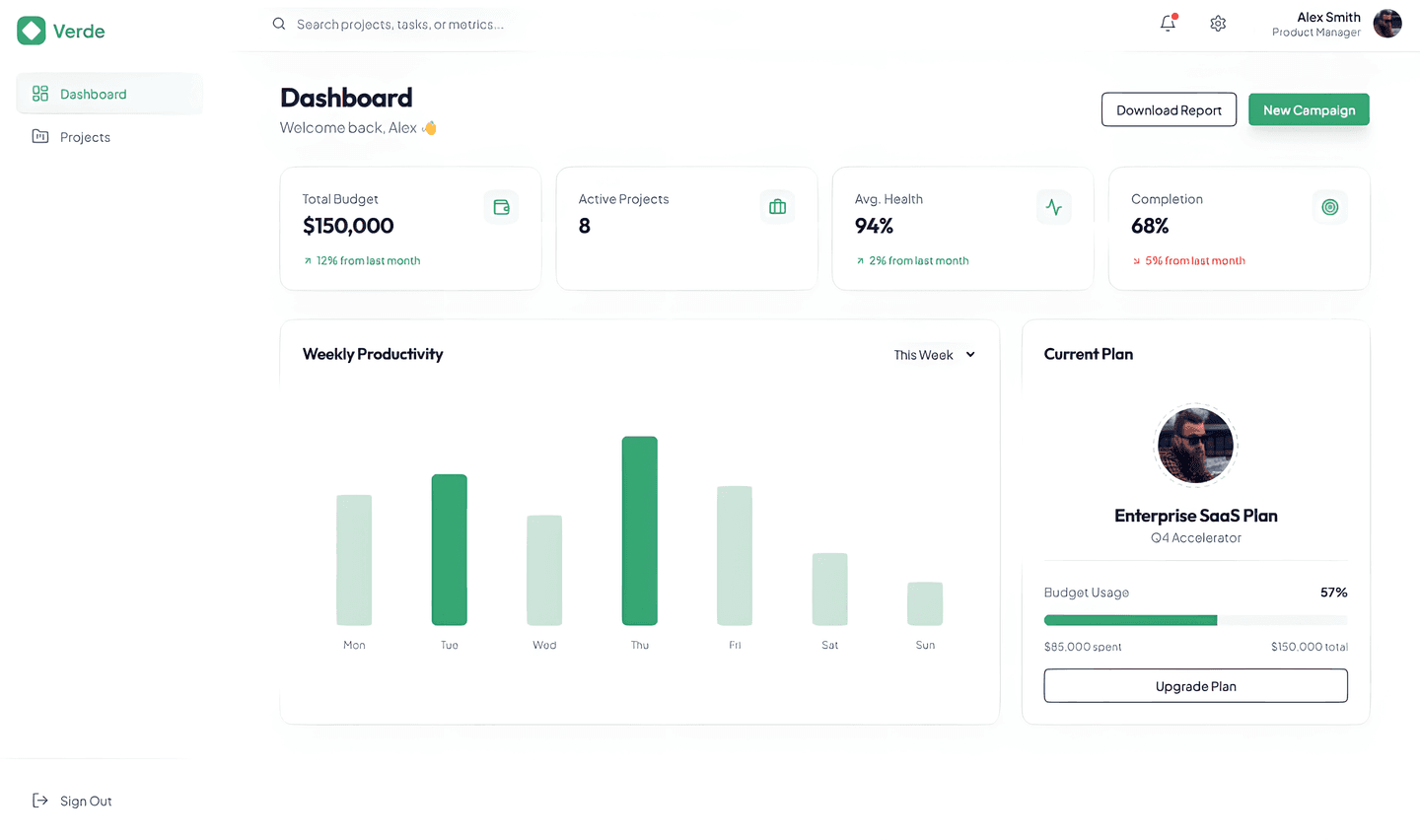
- Complex environmental data visualisation: The core of the platform is its analytics dashboard layer. Advantrix Labs implemented advanced charting and visualisation components purpose-built for environmental data, including time-series emissions charts, geographic resource consumption maps, Scope 1/2/3 breakdowns and compliance progress trackers. Rendering optimisations including virtualised lists, lazy-loaded chart components and efficient state management ensure that dashboards with thousands of data points render without layout shifts or perceptible delays
- Real-time data updates via API integration: The frontend integrates with backend services using modern state management to handle asynchronous data streams. As new environmental data flows into the system from connected sources, dashboards update in real time without requiring page refreshes. This ensures that sustainability teams always work with the latest metrics, a critical requirement for organisations monitoring emissions against reduction targets
- Enterprise SSO: The platform supports enterprise authentication with integration for Google, Microsoft and corporate identity providers. This enables single sign-on for organisations with existing identity management infrastructure, reducing onboarding friction for enterprise teams and satisfying security requirements during vendor procurement reviews
- Server-side rendering for SEO: Public-facing content, including sustainability benchmarks, methodology documentation and educational resources, is rendered server-side for effective search engine indexing. This ensures that search engines index the content effectively, driving organic traffic from sustainability professionals researching tools and compliance frameworks. SSR also improves initial page load performance for all users
- Vue.js integration with legacy modules: Rather than rewriting all existing functionality, Advantrix Labs engineered an integration layer that allows legacy modules to operate within the new application. This approach preserved the start-up's existing investment while enabling a phased migration to the modern stack, reducing delivery risk and time-to-market
- Optimised trial-to-paid conversion flow: The onboarding experience was designed to deliver value within the first session. New enterprise evaluators connect a sample data source, see their environmental data visualised on a dashboard and generate a draft compliance report within minutes of signing up. Contextual prompts guide users through key features and demonstrate capabilities that are gated behind paid tiers, reinforcing the case for subscription at natural decision points
Solution gallery
Product and workflow visuals from the delivered solution.
Business outcomes
By delivering a production-grade sustainability analytics platform with high-performance dashboards, enterprise authentication and an optimised conversion experience, Advantrix Labs enabled Verde to enter the enterprise ESG market with a credible, competitive product and begin acquiring its first enterprise customers.
- 42% increase in trial-to-paid conversion: The streamlined onboarding flow, immediate data visualisation and contextual upgrade prompts significantly improved conversion from trial to paid subscription. Enterprise evaluators who could see their own environmental data rendered in dashboards within the first session were far more likely to progress to procurement. Industry benchmarks suggest that top-performing B2B SaaS products achieve trial-to-paid rates above 25%, and the platform's conversion gains placed the start-up well above the median for its category
- 55% reduction in dashboard rendering latency: Rendering optimisations including virtualised components, lazy loading and efficient state management cut dashboard load times by more than half. For sustainability teams working with large datasets spanning multiple facilities and reporting periods, the performance improvement meant the difference between a tool that feels responsive and one that feels sluggish. Faster dashboards directly supported higher engagement and session duration
- 48% boost in user retention: The combination of intuitive UX, real-time data updates and a polished mobile-first design increased user retention significantly. Sustainability teams returned to the platform regularly to monitor metrics, track compliance progress and generate reports. Research from ProfitWell shows that product experience is the primary driver of retention in B2B SaaS, and the platform's usability improvements reduced churn among early enterprise customers
- Enterprise-ready foundation: OAuth 2.0 SSO, role-based access and a security-conscious architecture enabled the start-up to pass enterprise vendor reviews and onboard organisations with established procurement processes. This removed a barrier that prevents many early-stage SaaS companies from closing enterprise deals
- Scalable architecture for regulatory evolution: The modular frontend and flexible data model allow Verde to add support for new sustainability frameworks and reporting standards as regulations evolve, without re-engineering the core platform. As ESG disclosure requirements expand globally, the architecture positions the start-up to adapt quickly and serve a widening market